For Data Architects
You decide what the platform masters and how records resolve into golden records. Almost everything else is configured against your decisions, so the order below matters.
Start here
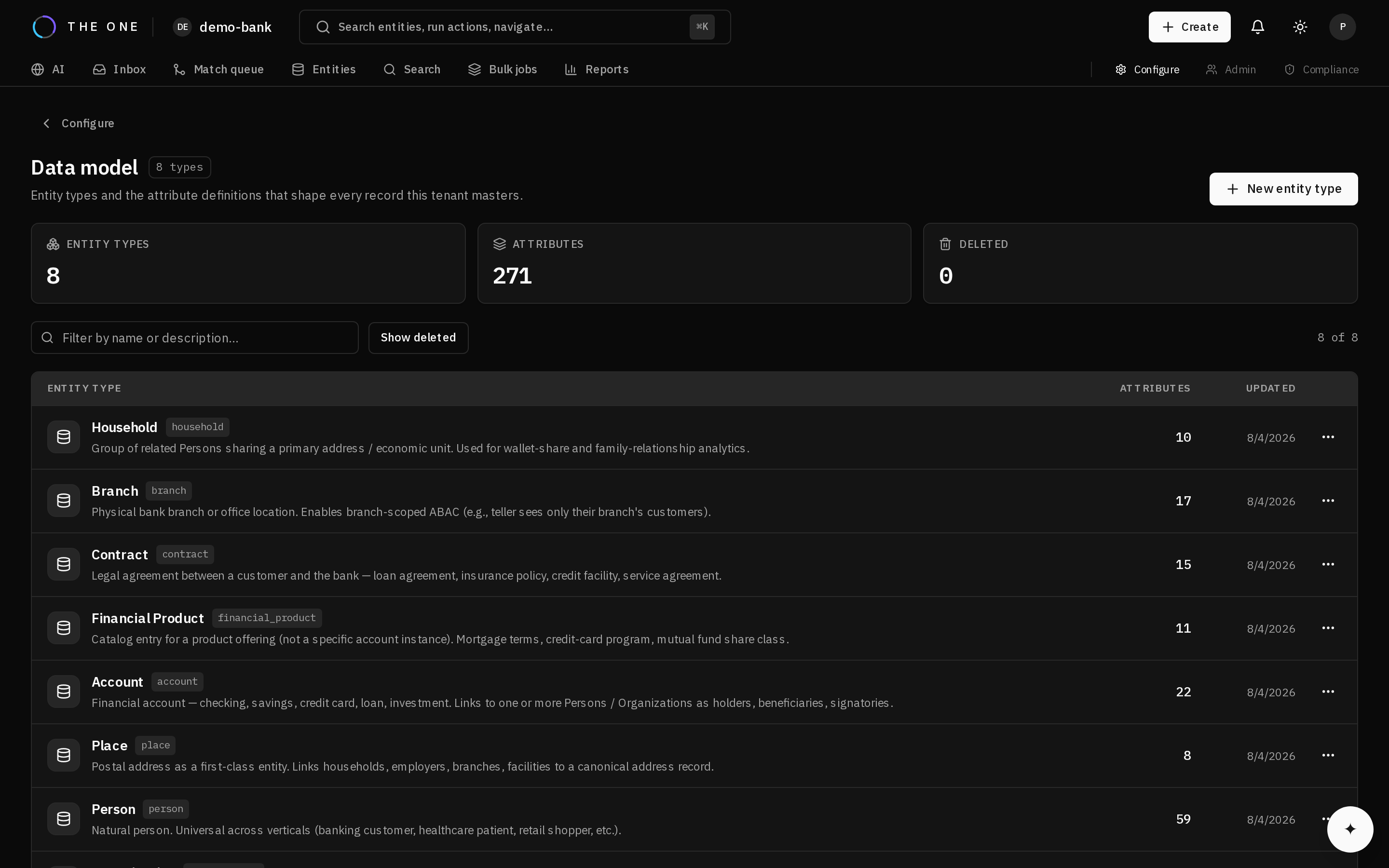 Where most of this role's work happens.
- The platform model — what the pipeline does
- Entities, crosswalks, and golden records
- Attributes and data types
Model the domain
- Model your data — entity types and attributes
- Manage reference data — controlled vocabularies
- Standardize data — canonical values
Do these in order. Matching compares canonical values, so standardization is part of modelling rather than a later refinement.
Configure resolution
Decisions that are expensive to reverse
| Decision | Why it is hard to change |
|---|---|
| Cardinality | Widening later means re-examining records that already lost values |
| Composite or scalar | Flattened structure is not recoverable |
| Lookup codes | Codes are stored on records; changing one orphans them |
| Reference binding | Retrofitting means cleaning every existing value |
Spend your time here. Thresholds are tuned continuously; a data model is not.
Next
- Install seed packs — start from a close fit rather than blank
- Data model reference