Tune Thresholds
The two thresholds decide what merges automatically, what a person reviews, and what is ignored. This page sets them from evidence rather than guesswork.
They are not on a 0–1 scale and not percentages. Each whole point doubles the strength of the evidence required, so a threshold of 12 asks for roughly four thousand times more support for a match than for a coincidence. Most other platforms use a bounded score, which makes this the commonest source of mis-tuning. See how probabilistic scoring works.
Before you start
- An active match profile with blocking and comparison ladders configured.
- Labelled pairs — pairs you have confirmed as matches or non-matches. This is the input everything here depends on; without it you are guessing.
- Permissions for each step:
match.labeled-pair.createto build the labelled set,match.profile.evaluateto evaluate,match.profile.calibrate-weightsto calibrate,match.profile.optimize-thresholdsto optimise, andmatch-profile.updateto save the result. Missing any one fails that step alone.
1. Build a labelled set
Label from your own data, not synthetic examples. The pairs that matter are the hard ones:
- Confirmed matches, especially awkward ones — a name change, a transcription error, a missing field.
- Confirmed non-matches that look similar — a father and son at one address, two people sharing a common name and city. These are what stop the auto-link threshold from being set too low.
A labelled set of only easy cases produces thresholds that fail on exactly the cases you built the system for.
2. Evaluate the current profile
Evaluation scores every labelled pair with the active configuration and reports precision, recall, and the score distribution.
Read the distribution, not just the headline numbers: where do known matches cluster, where do known non-matches cluster, and how much do the two overlap? The overlap is your clerical review band. If it is enormous, no threshold will save you — the discriminating power has to come from better blocking, better ladders, or better weights.
3. Calibrate weights
Rather than hand-setting the two probabilities per level, fit them from the labelled set: how often each level occurs among true matches, and how often among true non-matches.
Calibration is guarded — a fitted set that would lower measured quality is reported and not applied. Trust the guard; a calibration that degrades results usually means the labelled set is unrepresentative, not that the fit is wrong.
4. Set the thresholds
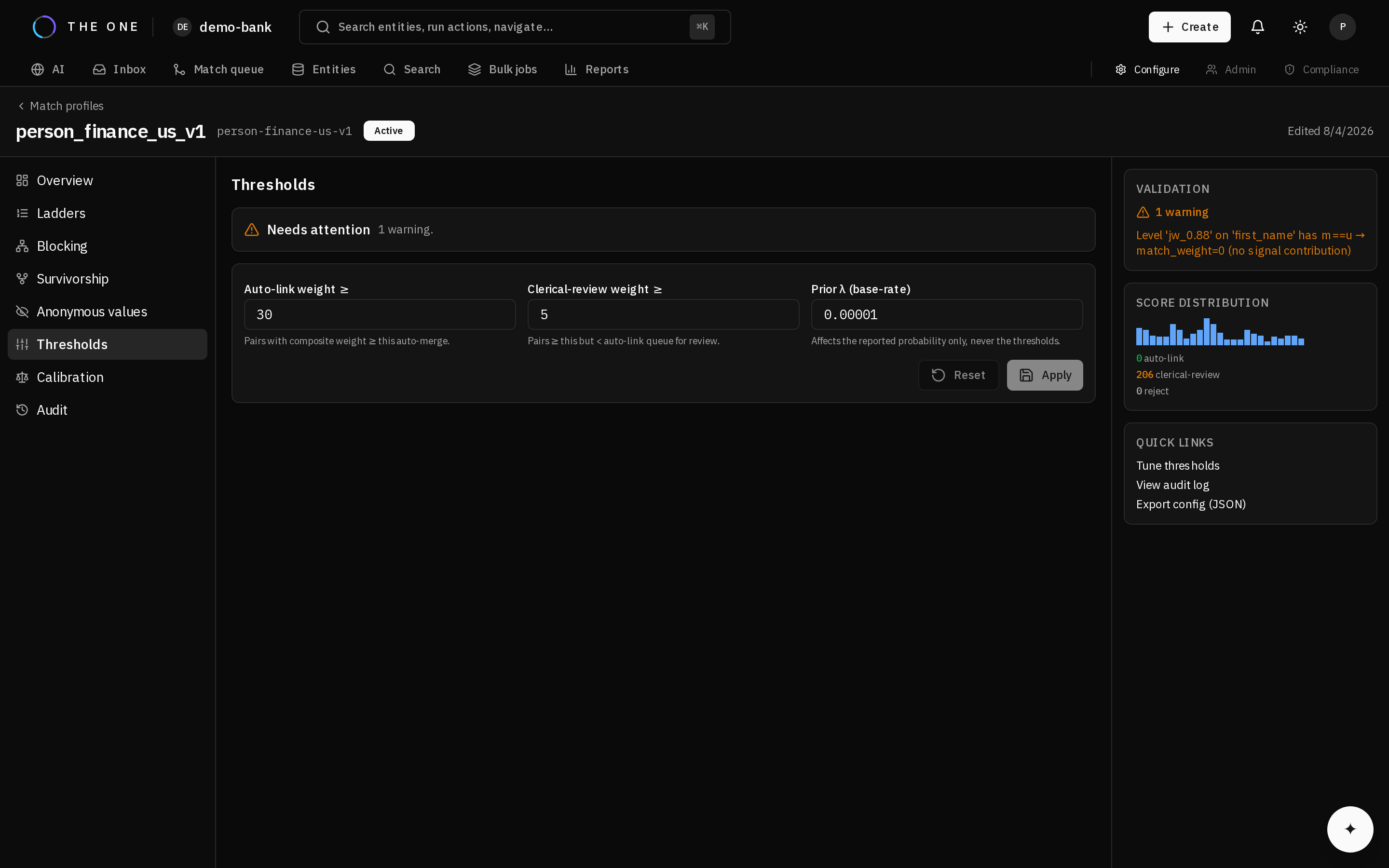 The Thresholds tab. The distribution shows how many pairs fall either side of each line.
The two are chosen on different principles.
Auto-link is set by precision. It must sit above every known non-match, so nothing the labelled data says is not a match can merge unattended. A balanced measure like F1 cannot help here: it counts auto-linked and clerically-reviewed pairs alike, so it is structurally blind to where the auto-link line sits.
Clerical review is set by capacity. Lower it and you catch more true duplicates but queue more pairs. This is an operational decision — set it to the volume your stewards can actually work through, then revisit as the queue drains.
Try a pair of thresholds before you commit to them. Project the effect of proposed values and the platform answers what would happen — how many pairs would merge unattended, how many would land in the review queue — without changing the profile or touching a record. That is the number to take to whoever owns the stewardship rota, and it is the difference between setting a review threshold and discovering next week that it produced a queue nobody can clear.
5. Add a minimum-agreement rule
Threshold tuning cannot protect against a single attribute carrying an entire match on its own. Requiring agreement on several distinct attributes before auto-linking is threshold-independent — it holds even if a threshold is later mis-set.
Set it on any entity type with rich identity data. Records that genuinely match almost always agree on more than one thing.
6. Re-evaluate and verify
Re-run evaluation and confirm precision on the auto-link tier is what you require. Then dry-run against real records and inspect the tiers.
The threshold must be reachable. If the auto-link threshold exceeds the total weight available from all your ladders combined, nothing can ever auto-link and the entity type will silently never merge. Add up the maximum weight across every ladder and leave real headroom — frequency adjustment only ever weakens evidence, so a threshold needing flawless agreement everywhere is unreachable in practice too.
The review band must not be empty. If the clerical review threshold is at or above the auto-link threshold there is no review band, and every pair either merges or vanishes.