Working with Entities
Entities are what the platform masters: how they are created, how they are read, and what the 360 view assembles.
Entities and their sources
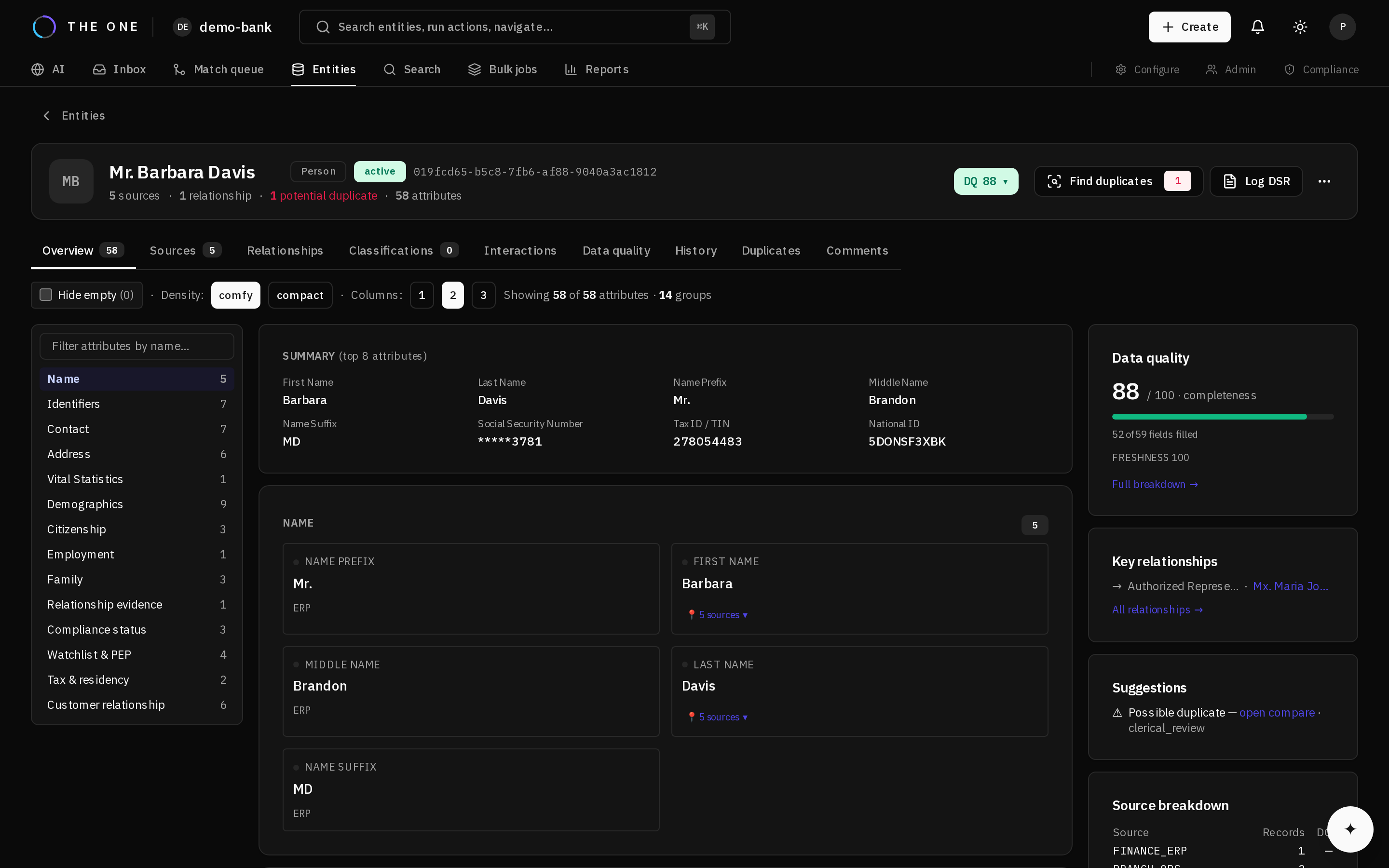 The 360 view. The tab strip is the connected data described below; the attributes shown are the golden record.
An entity is one real-world thing. Behind it sit the source records that contributed to it, each linked by a crosswalk recording which system it came from and that system's identifier for it.
A crosswalk links a record to a source system. Mapping one system's code value to a canonical one is a different thing, called transcoding. Some platforms use the word "crosswalk" for that second idea; here it always means the link to a source record.
This is what makes lineage answerable. For any value on a golden record you can determine which system supplied it, and when.
The 360 view
Reading an entity returns the entity. Reading its 360 view returns everything connected to it:
| Included | What it tells you |
|---|---|
| Attributes | The golden values, with their contributing sources |
| Crosswalks | Which systems know this entity, and by what identifier |
| Relationships | Links to other entities, in both directions |
| Interactions | Recorded events involving it |
| Consent records | What it has consented to, and on what basis |
| Merge history | What was absorbed into it, and when |
| Data quality | Its current score and outstanding violations |
You may know the 360 view as a profile.
Attributes and provenance
Each attribute on a golden record carries its contributing sources, so you can see not only the winning value but what each system said and why this one won.
When several systems disagree, survivorship decided the outcome — and the 360 view shows you the inputs that decision was made from.
Masking applies everywhere
Field masking is applied when the response is generated, on every surface that returns entity data — reading an entity, the 360 view, search results, match comparison screens, audit entries.
Because masking is applied on response generation rather than per screen, there is no endpoint that returns an unmasked value to a caller who lacks permission. A masked value in the console is masked in the API and in the AI layer too.
Merged entities
When entities merge, the absorbed record does not disappear. It becomes a resolvable alias: requesting it resolves to the survivor, and the response says so. Integrations holding an old identifier keep working.
Merges are reversible. Unmerging restores the absorbed record with the state it carried.