Read the 360 View
Before you start
The entity.read permission. It gates everything this response returns — there
is no per-section permission within it, so a caller who can read the entity
receives every section of it. Interactions and consent records are read
separately, each behind its own permission.
1. Read the entity
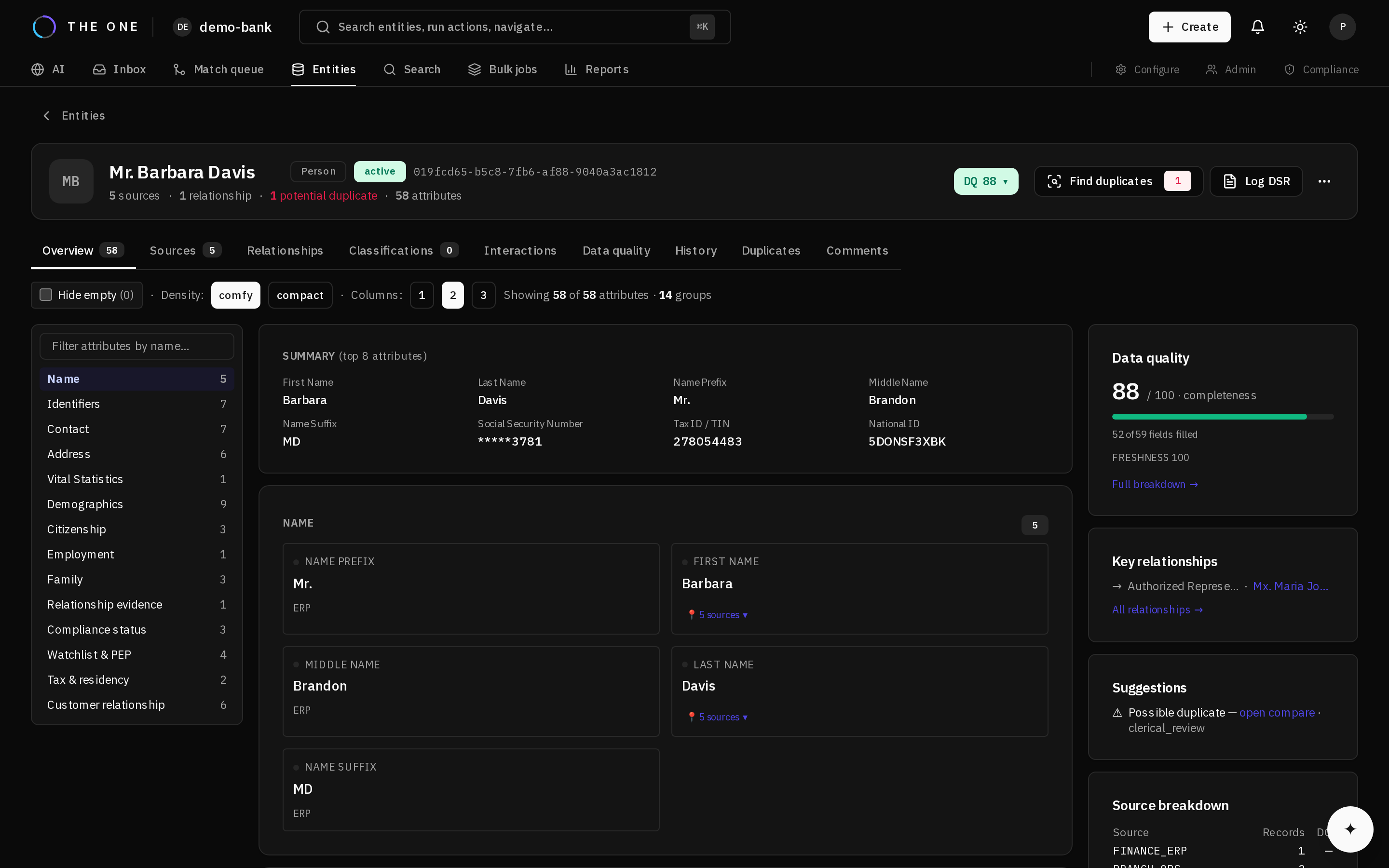 The entity's own attributes — the golden record, with each value's contributing sources collapsed under it.
Returns the golden record: one value per attribute, with the status and type.
2. Read the 360 view
Returns the entity plus what is governed alongside it — crosswalks, relationships in both directions, merge history, and the data quality score.
Interactions and consent records are not in this response. They are related to the entity but read separately, each behind its own permission.
You may know this as a profile.
3. Trace a value to its source
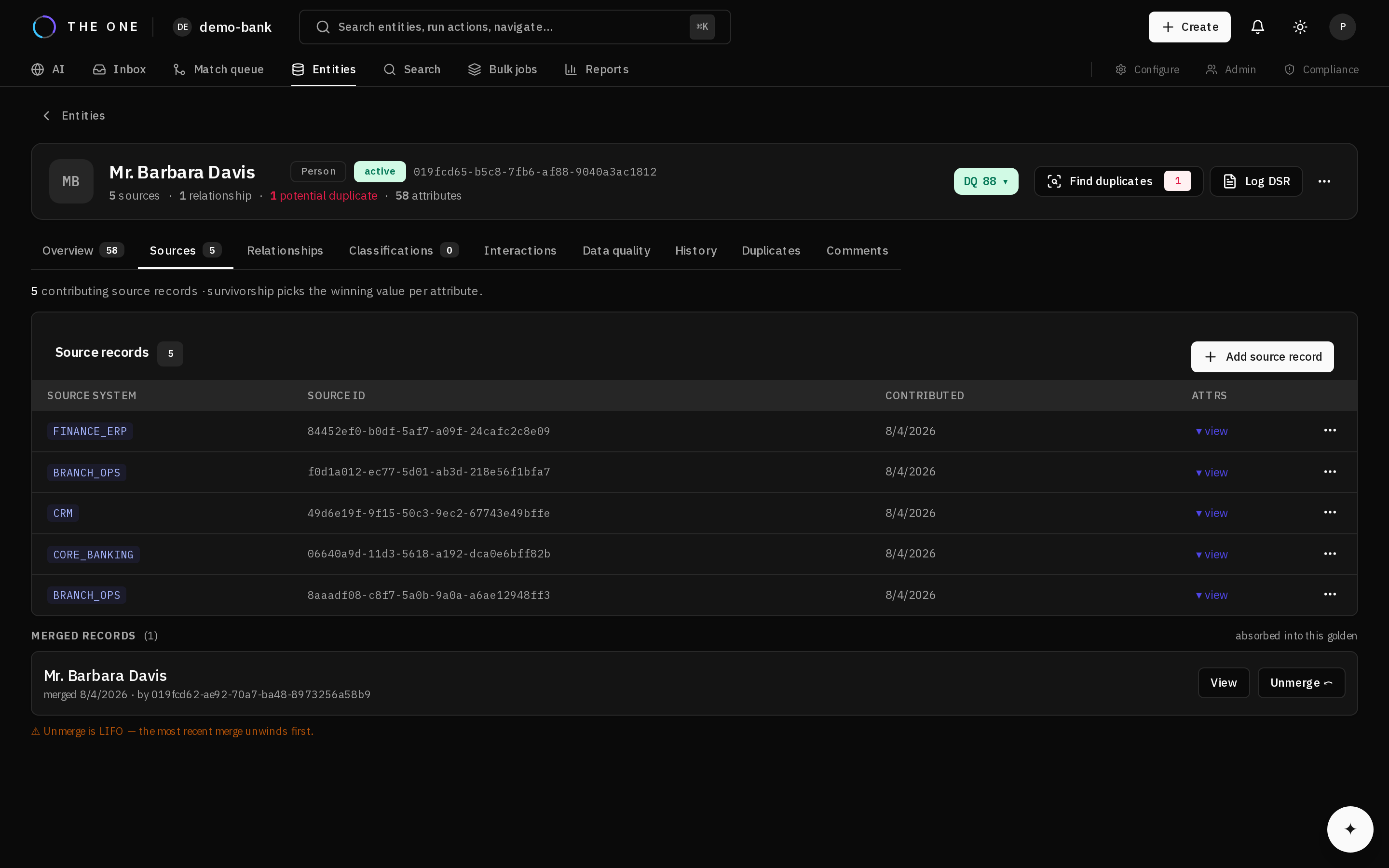 The Sources tab. Every contributing record is listed with the system it came from.
Each attribute carries its contributing sources. For any value you can see what each system supplied and which won.
This is the question worth being able to answer when someone disputes a value. "The golden record says X" is unconvincing; "the billing system supplied X on this date, the CRM supplied Y earlier, and the rule prefers the more recent" is not.
4. Read merge history
 The History tab. Merges appear here alongside ordinary edits.
Shows what was absorbed into this entity and when. Each absorbed record remains resolvable — requesting it returns the survivor, with the response saying so.
5. Understand what is missing
 The same record, seen by a restricted account. Social Security Number, Tax ID and National ID are redacted to their last four characters; the name fields are not. Masking is applied when the response is generated, so the browser never receives the full values.
A 360 view reflects the caller's permissions on its contents:
- Individual records hidden by a ABAC policy are absent, not marked as hidden.
- Masked values appear masked.
If a relationship you expect is missing, it may exist and be hidden from you by a ABAC policy. The response does not distinguish "none" from "denied", deliberately — revealing that something exists but is withheld is itself a disclosure.
This bites hardest when reconciling counts against a source system, where the mismatch reads as data loss.