Events Reference
Webhook settings
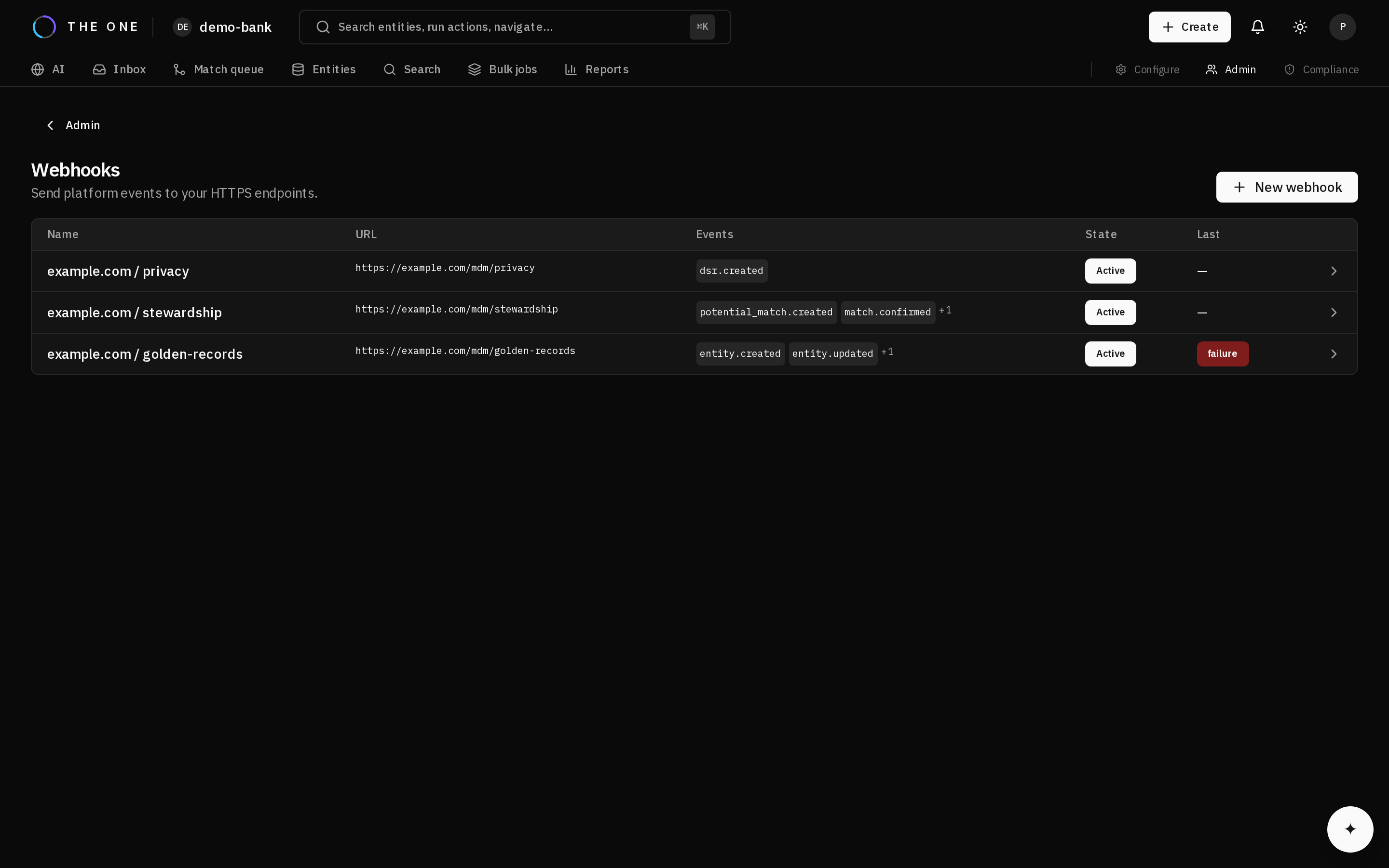 Webhook subscriptions. The settings below are what each row carries.
| Setting | Purpose |
|---|---|
| Destination | Where deliveries are sent |
| Event types | What triggers a delivery |
| Secret | Shared value the receiver uses to verify the caller |
| Active | Whether deliveries are attempted |
Delivery behaviour
| Property | Value |
|---|---|
| Semantics | At-most-once — no automatic retry; a failed delivery can be re-sent manually |
| Timeout | Short; a slow consumer is a failed delivery |
| Ordering | Not guaranteed |
| Failure impact | None on the originating operation, which has already committed |
| Recording | Real deliveries and manual re-sends are recorded with their outcome. A test-fire is not — its result is returned to you at the time and stored nowhere, so it never appears in delivery history. |
| Success signal | A 2xx response, which also emits an audit entry |
Destination validation
Validated at five points: creation, update, test-fire, manual retry, and delivery.
The resolved address is pinned, so a destination cannot pass validation and then resolve elsewhere at delivery time. A rejected destination emits a security audit entry.
This exists because a webhook is an outbound request to an address a tenant supplies, which is otherwise a route to internal infrastructure.
Loop guard
Events about webhooks are never themselves delivered. A webhook subscribing to its own event types cannot cause a feedback storm.
Current limitations
State these plainly rather than discovering them in production:
| Limitation | Consequence |
|---|---|
| No automatic retry | A failed delivery stays failed until someone re-sends it. Reconcile against the API. |
| Secret stored as supplied | Treat it as a shared secret, not a credential |
| No signature header | The secret travels in the body for comparison |
| No per-tenant key rotation | Rotate by updating the webhook |
If your security review requires signature-based verification, raise it as a gap. It is a reasonable ask; it is not present today.