AI Security Model
The principle
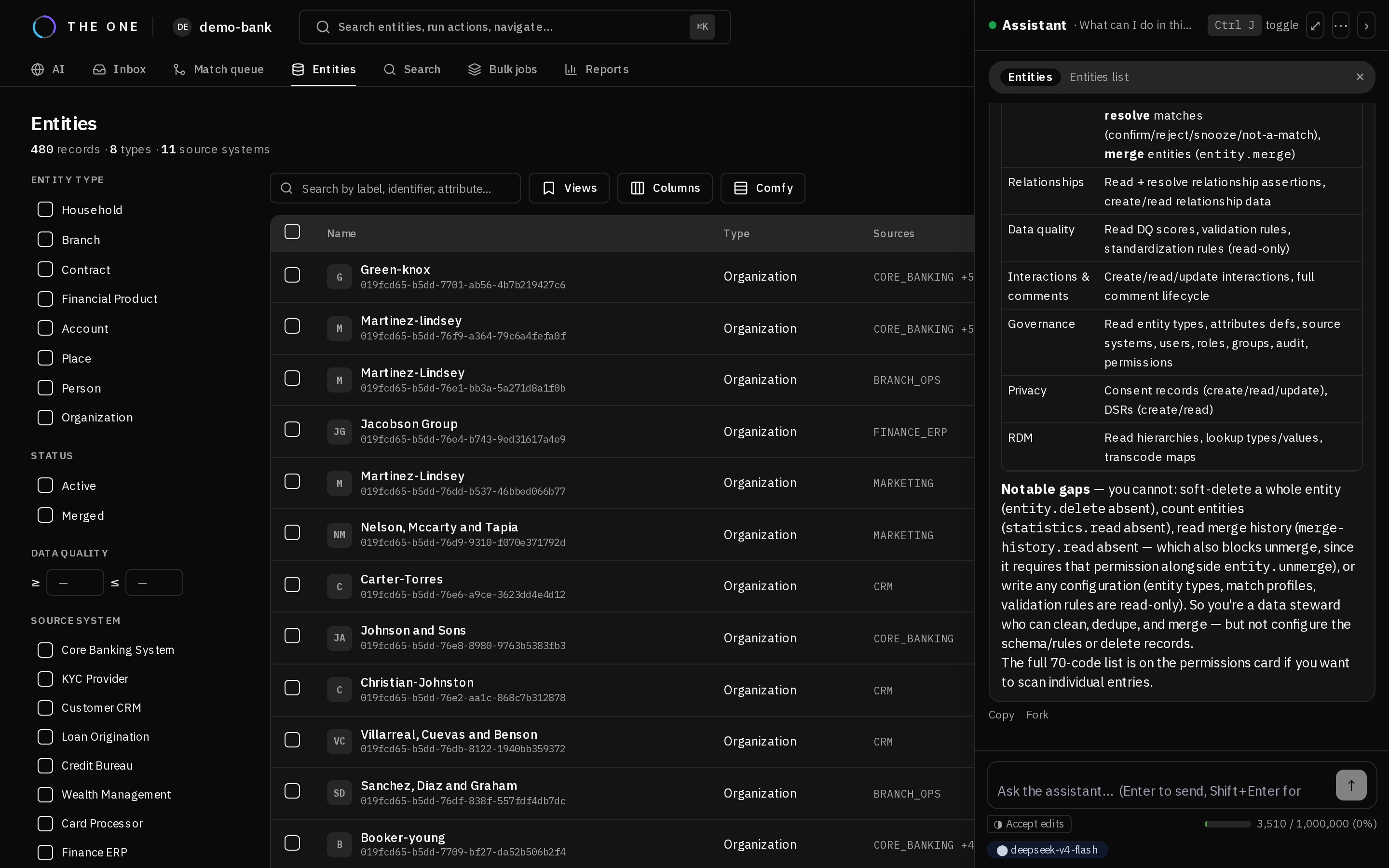 Asked what it can do, the assistant reports the caller's own effective permissions — including what is missing. Here it names the absent codes and concludes the account is a steward who can clean, dedupe and merge, but cannot configure the schema or delete records.
An agent acts as its caller. The AI layer holds no identity of its own — no broker credential, and nothing privileged to fall back on when the caller's own permissions run out.
This is the whole security model, and it is deliberately boring. An agent's reach is exactly the reach of the credential it carries, so reasoning about what an agent can do reduces to reasoning about what that caller can do — a question you already know how to answer.
Usually the caller is a signed-in person. An agent that runs unattended presents a system token instead, provisioned by an administrator for the purpose. A system token is a principal in its own right, with its own permissions, and every layer below evaluates it exactly as it evaluates a person. What changes is who you have to reason about — never how much is checked.
What an agent cannot do
| Cannot | Because |
|---|---|
| See data its operator cannot see | Every enforcement layer re-evaluates per request |
| Reconstruct a masked value | It receives the mask; masking is applied when the response is generated |
| Escalate its permissions | It holds no identity of its own to escalate |
| Act untraceably | Every action is audited, attributed to the user |
| Mutate in one unconsidered step | Mutations are gated behind an explicit preview-then-commit |
Untrusted data
Master data contains free text supplied by other people — names, comments, descriptions, request bodies. Any of it can contain text that reads like an instruction.
The system prompt instructs the model to treat tool output as untrusted data and to fence it when surfacing it.
Tool results are returned as raw API responses; the server does not currently wrap them in an untrusted-data envelope. So this mitigation depends on the model following instruction, which is exactly the assumption prompt injection attacks.
The load-bearing defence is the permission model, not the prompt. Even a fully subverted agent carries only the operating user's permissions, so the worst it can reach is what that person could have reached anyway — and every action it takes is audited under their identity.
Treat the fencing instruction as defence in depth. If your threat model requires server-side enforcement, raise it as a gap rather than assuming it is present.
Masked values
An agent receives masked values as masks and can only repeat them. It has nothing to reconstruct from.
Instructing it to unmask is not refused by policy — it is not possible. The value is not present in what the agent received.
Autonomy is not authorization
An autonomy mode governs whether a person is consulted before an action. It never governs what the underlying request is permitted to do.
An agent in the most permissive mode, operating for a read-only user, still cannot write. The request is refused exactly where any other unauthorized request is refused.
Mutations
Mutating operations require an explicit two-step: a preview showing what would change, then a commit. An agent cannot self-confirm — the confirmation is not something it can produce on its own.
Every exposed mutation is reversible, which is what makes the more permissive autonomy modes defensible.
Auditing
Agent actions land in the same append-only audit log as any other action, attributed to the user whose identity was used. There is no separate, less-traceable path.