The In-app Assistant
A chat surface inside the console, aware of the page you are on.
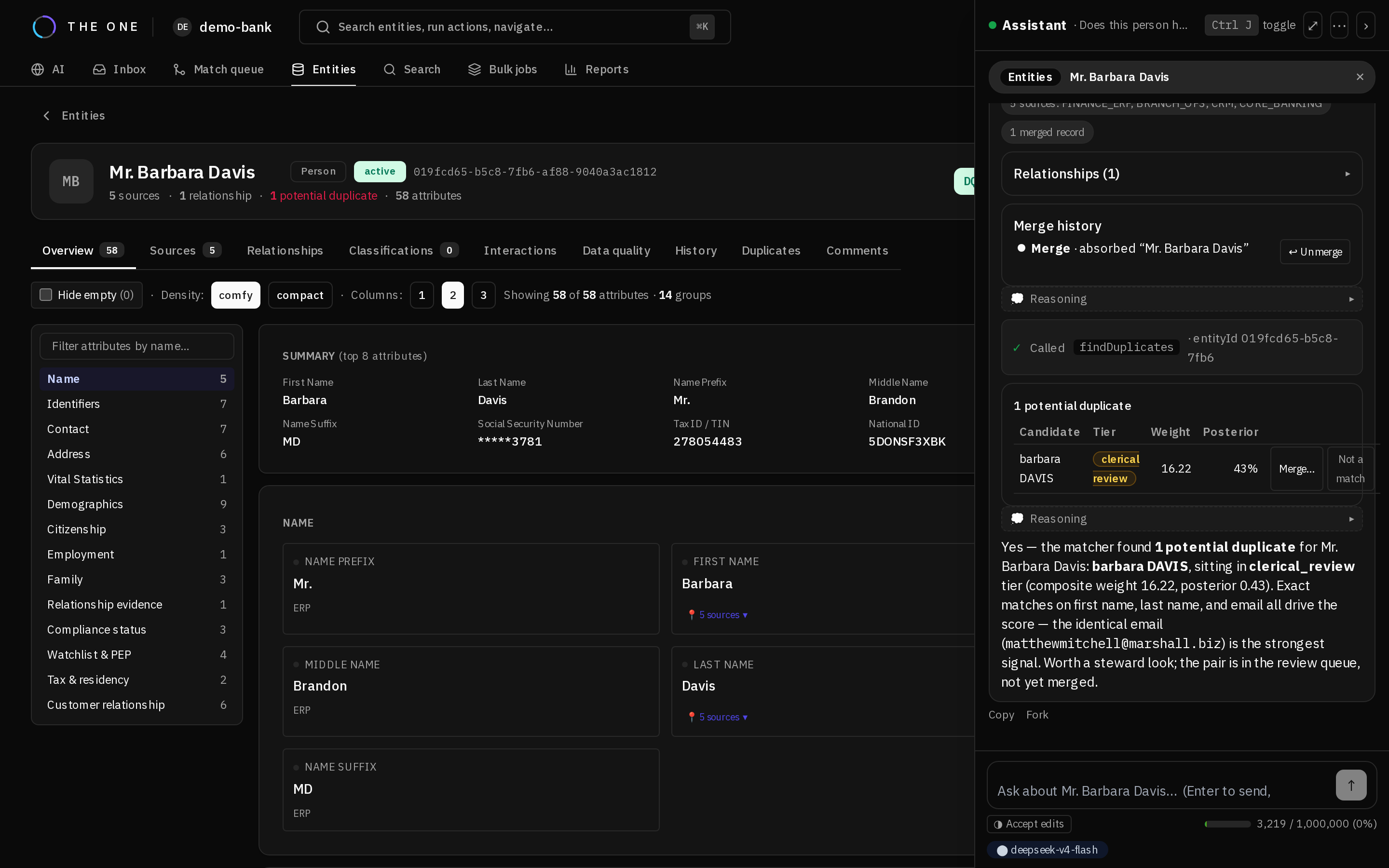 Asked about the record on screen, the assistant runs real duplicate detection and shows its work: the operation it called, the candidate with its tier, weight and posterior, and the actions available. The numbers are the platform's, not the model's.
What it is good at
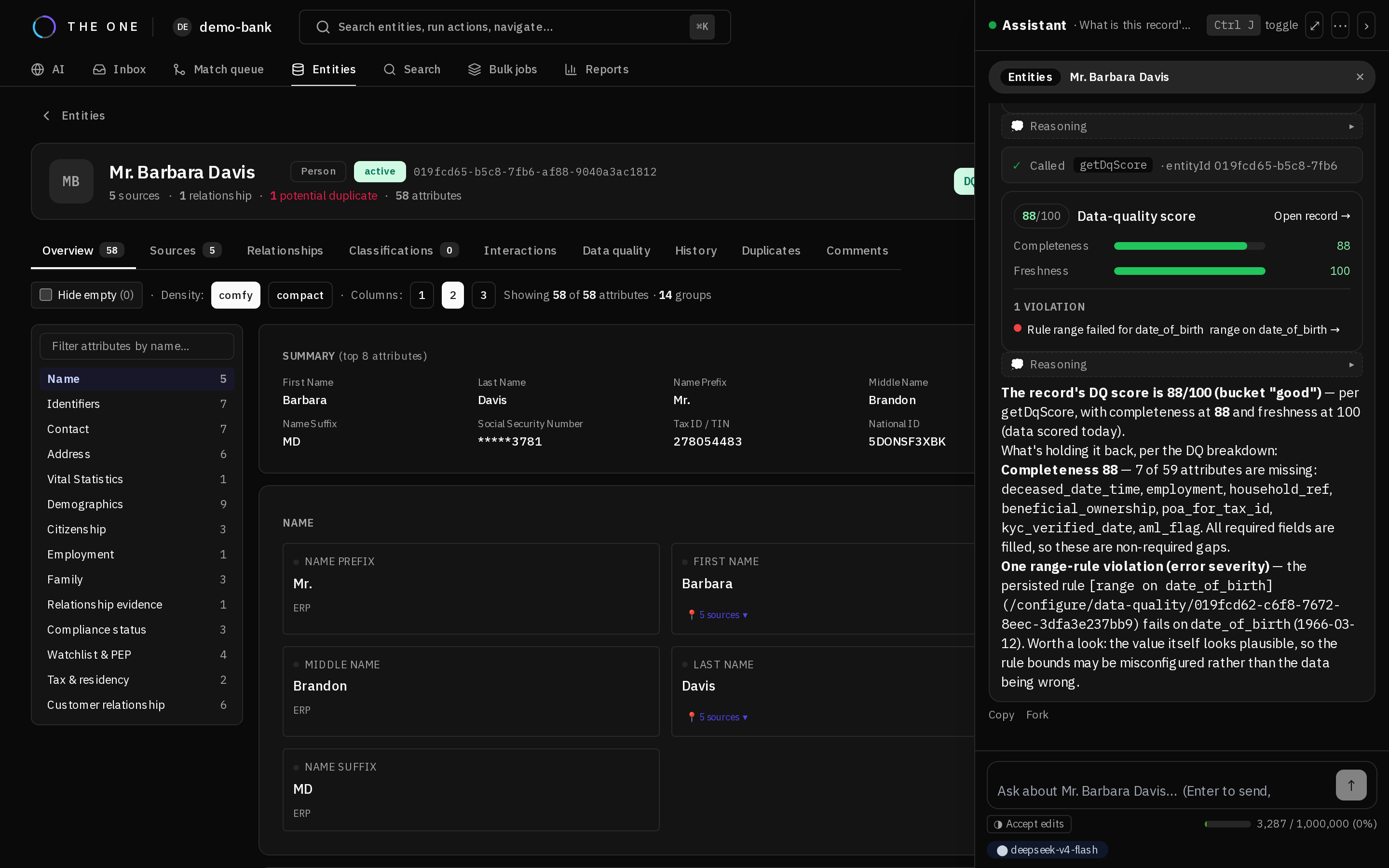 A quality score read from the platform, not estimated: 88 out of 100, completeness 88, freshness 100, and the one rule violation behind it. The assistant names the operation it called and adds the judgement a steward needs — the date looks plausible, so the rule bounds may be what is wrong.
| Ask it | Because |
|---|---|
| "Why did these two records match?" | It reads the scoring breakdown rather than guessing |
| "Does this person appear anywhere else?" | It runs real duplicate detection |
| "What is this record's data quality score?" | It reads the score and its dimensions |
| "What can this user do?" | It resolves effective permissions |
What it will not do
- Invent values. It renders what the API returned, including masked ones.
- Recompute numbers. Scores and weights come from the platform, not the model.
- Claim certainty it lacks. It is instructed to say it does not know rather than fabricate, and to cite the operation behind a claim.
- Exceed your permissions. It acts as you.
Autonomy modes
Set per conversation:
| Mode | Behaviour |
|---|---|
| Manual | Every action is approved individually |
| Accept edits | Reversible actions proceed; destructive ones ask. The default. |
| Auto | Actions proceed without asking |
Autonomy governs whether you are asked. It never governs what the request is allowed to do. In auto mode, an action you lack permission for is still refused — exactly where any other unauthorized request is refused.
Approving an action
When approval is needed, the assistant shows what it intends to do — the operation, the records affected, and whether it is reversible — and waits.
Approve and it proceeds. Deny and nothing happens.
The input shown to you is the input that will be used, with masking applied as everywhere else. You are approving a specific action, not a general intent.
Reversibility
Every mutation the assistant can perform is reversible: a merge can be unmerged, a soft delete restored. This is what makes the more permissive autonomy modes defensible, and it is why the exposed set is curated rather than being the whole API.
Masked values
If a value is masked for you, it is masked in the assistant. It cannot reconstruct it and will not pretend to. Asking it to unmask is not refused by policy — the value simply is not in what it received.
Page awareness
The assistant knows which record you are looking at, so "does this person have duplicates?" resolves without you supplying an identifier.
The page context is treated as untrusted input: the assistant re-fetches the record through the API rather than trusting what the page displayed.